
It sounds wild, but psychologists and even genetic researchers have long been obsessed with one oddly specific body part: your fingers.
According to several studies, the length and shape of your fingers might reveal hidden clues about your confidence, emotional intelligence, romantic behavior, and even your instincts in business or leadership.
Some call it pseudoscience, others swear by it. But once you look down at your hands after reading this, you’ll never see them the same way again.
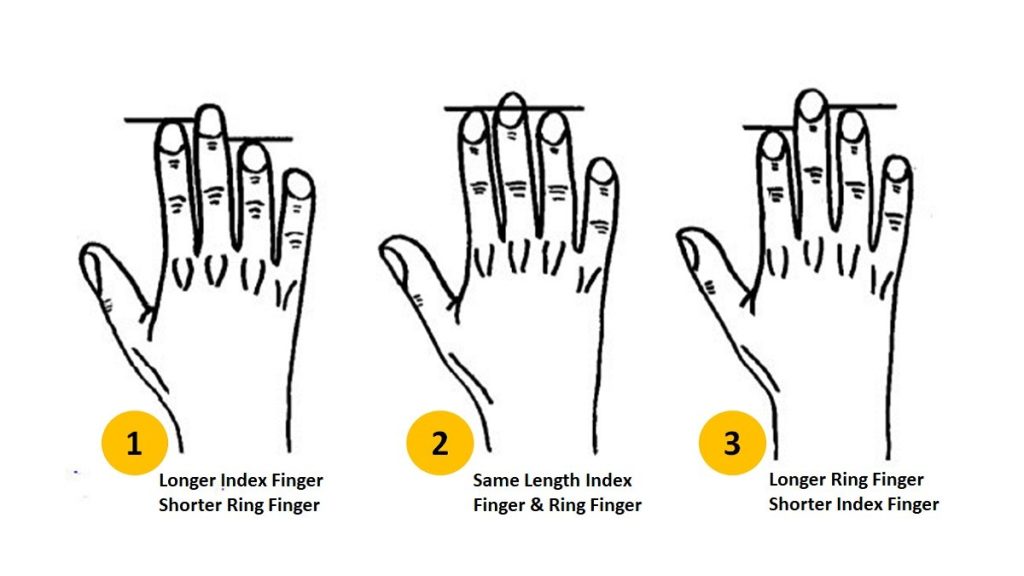
Grab your hand right now and stretch your fingers flat on the table. Pay attention to your index finger — the one next to your thumb — and your ring finger — the one you wear a ring on.
Their lengths, and how they compare to one another, might be telling a story about who you really are deep down.
The Strange Science Behind “Finger Personality”
This entire theory comes from something scientists call the digit ratio — the comparison between the length of your second finger (index) and your fourth finger (ring).
At first, this might sound like another internet myth, but research from major universities like Cambridge, Oxford, and the University of Alberta has actually explored how this ratio relates to hormones we’re exposed to before birth — particularly testosterone and estrogen.
Testosterone influences things like competitiveness, confidence, and spatial awareness. Estrogen, on the other hand, is linked to empathy, communication, and emotional intelligence. The theory suggests that if you were exposed to higher levels of testosterone in the womb, your ring finger might end up longer. If you were exposed to more estrogen, your index finger could be longer.
In other words, your hands might be carrying biological “fingerprints” of the hormonal balance that shaped your brain and behavior long before you were even born.
Why People Are Obsessed With This
It’s not just TikTok or Facebook making finger-length theories viral.
Over the years, scientists have linked digit ratios to a surprising range of traits: from how well you handle stress to how likely you are to succeed in leadership roles.
For example, one 2002 study from the British Journal of Psychology found that men with longer ring fingers than index fingers were statistically more likely to perform better in competitive environments — especially sports.
Meanwhile, people with equal finger lengths scored higher on measures of emotional stability and communication.
And those with longer index fingers? They tended to be calmer, more introspective, and surprisingly patient under pressure.
Of course, none of this means you’re “doomed” by your hand shape. These patterns are fun correlations, not fate. Still, when millions of people online start comparing hands and realizing how eerily accurate some of these descriptions feel, it’s no wonder the internet can’t stop talking about it.